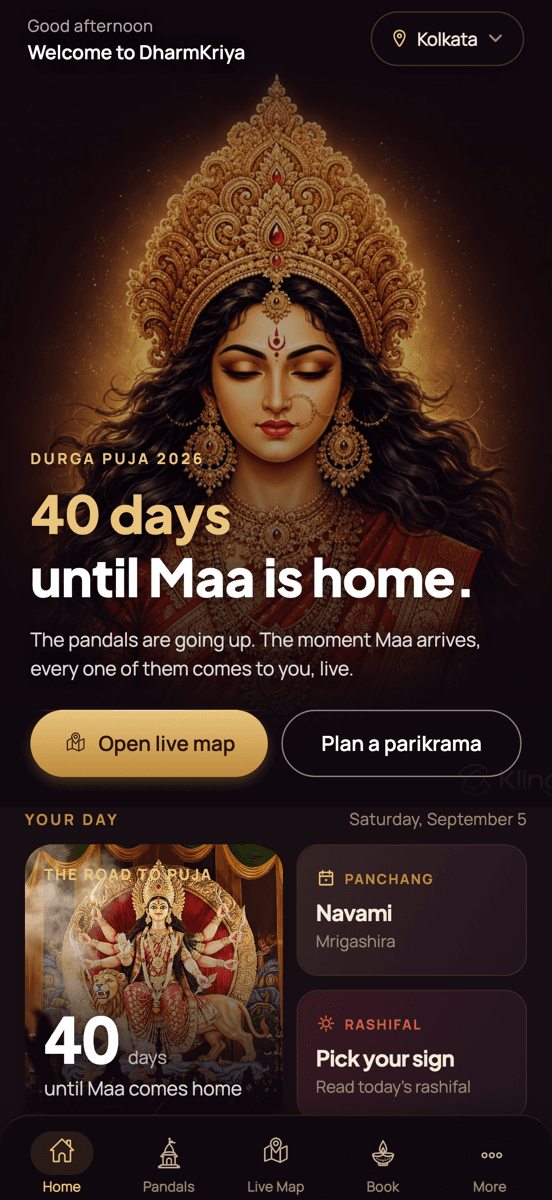
Durga Puja is the grand autumn worship of Durga, the ten-armed warrior mother who, riding her lion, slays the shape-shifting buffalo-demon Mahishasura. The story is told in the Devi Mahatmya, the Chandi, set within the Markandeya Purana: the demon had won a boon that no man or god could kill him, and grown invincible, he drove the gods from heaven. Unable to defeat him one by one, they pooled their fury into a single blaze of light, and from it rose Durga, each god lending her a weapon for one of her ten hands. For nine nights they battled, and as Mahishasura shifted his form from buffalo to lion to man, she struck him down at the exact moment he emerged half-formed from the beast. That is why she is honoured as Mahishasuramardini, the slayer of Mahishasura, and her worship is a celebration of good over evil and of the divine feminine, the Shakti, as the animating power of the universe.
ॐ · संसाधन
इतिहास और उद्गम
How an autumn worship of the warrior mother grew from the zamindar's courtyard into a heritage of humanity.
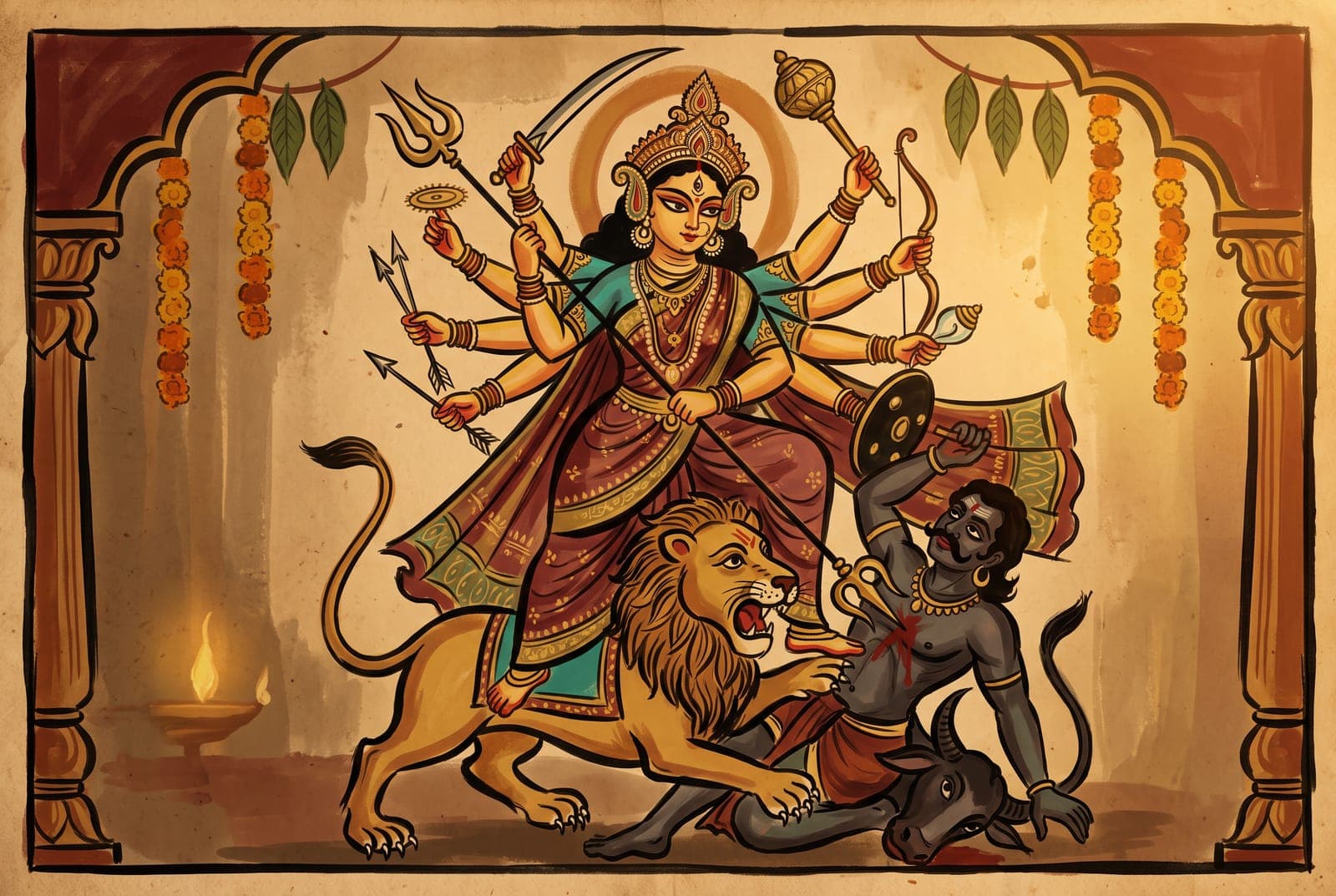
“Akalbodhon, the untimely awakening”
Durga Puja traditionally belonged to spring, the Basanti Puja, but Bengal keeps it in autumn on the strength of a second legend. In the Krittivasi Ramayana, Rama, needing the goddess's blessing before his battle with Ravana, could not wait for spring and invoked her out of season. The gods sleep through the autumn months, so to wake her early was a transgression, an akal bodhon, an awakening at the wrong time, and legend says Rama offered one hundred and eight blue lotuses and, finding one missing, made to offer his own eye in its place before the goddess stayed his hand. It is this untimely invocation that fixed the great puja in Sharat, the early autumn, where it has stayed ever since.
From the zamindar's courtyard to the people's festival
For centuries the puja was the preserve of wealthy landlords, the private barir pujo held in the thakur dalan, the pillared worship hall, of Bengali zamindari households. Its grandest early form was the puja of Raja Nabakrishna Deb of Shobhabazar in 1757, a lavish affair staged in the year of Plassey and open to the colonial gentry rather than the common people. The turning point came in 1790 at Guptipara in Hooghly, where twelve friends, shut out of a family puja, pooled public subscriptions to hold a celebration of their own. It became the barowari puja, from baro yaari, twelve friends. Over the following century this subscription model matured into the sarbojanin, the puja for all, with the landmark community puja at Baghbazar in Calcutta in 1910 throwing the goddess open to every worshipper regardless of caste or purse.
The clay, and the hands of Kumartuli
The idol is born months before the festival in Kumartuli, the potters' quarter of north Kolkata, where families of kumors have shaped the goddess for generations. The frame is bound from bamboo and straw, packed with clay drawn from the banks of the Hooghly, and tradition asks that a handful of punya mati, sacred earth from the threshold of a courtesan's home, be mixed in, so that the goddess carries into herself even those the world casts out. The idol is painted and dressed, and only at the very end, on Mahalaya, are the eyes drawn in, the Chokkhu Daan, the gift of sight that is said to breathe life into the clay.
The pandal as an art form
The modern festival is as much an exhibition as a worship. Neighbourhood committees commission temporary pavilions, the pandals, and compete each year to outdo one another, a rivalry that has turned Kolkata into an open-air gallery for a week. Theme pujas, the sarbojanin thakur built around a single idea, transform bamboo and cloth into replicas of temples, ships, or entire imagined worlds, and draw trained artists and designers whose installations are judged, awarded, and argued over across the city. What began as household devotion is now a season in which lakhs of people walk the streets from dusk to dawn to see what the city's artisans have made.
A heritage of humanity
The five days close with Bijoya Dashami, when married women smear the goddess with vermilion in Sindoor Khela and bid her farewell, and the idols are carried in procession to the river for immersion, the bisarjan, returning the clay to the water it came from. On 15 December 2021, Durga Puja in Kolkata was inscribed on the UNESCO Representative List of the Intangible Cultural Heritage of Humanity, the first festival from Asia to be so recognised, honoured for its artistry, its collapsing of distinctions of religion and class, and the way an entire city gives itself over, year after year, to welcoming the daughter home and letting her go.
A festival through time
1790
Twelve friends in Guptipara pool public funds for the first community barowari puja.
1910
The first fully public sarbojanin puja is organised at Baghbazar, Calcutta.
1931
Mahishasuramardini first airs on radio at dawn, voiced by Birendra Krishna Bhadra.
2021
UNESCO inscribes Durga Puja in Kolkata as Intangible Cultural Heritage of Humanity.