
Numerology / Ank Jyotish
Your numbers,
read the Indian way
Your and with their ruling planets, the Chaldean and Pythagorean name numbers, and the of strengths and missing numbers, with the remedies pandits actually suggest.
Numerology reading
Read your numbers
Your name and date of birth are all it takes for your core numbers.
New to numbers? Here is how the reading works before you cast yours.
Understanding Ank Jyotish
The numbers behind a life
Ank Jyotish, the Indian science of numbers, holds that the date you were born and the name you carry each reduce to a single vibration, and that these vibrations describe how you meet the world. It sits beside jyotish rather than replacing it: where the kundli reads the planets, the numbers read their echo in ordinary life.
Each number one through nine is ruled by a graha, and a reading is really the story of which planets speak loudest in your numbers, and which stay quiet.
Your two core numbers
Mulank, the birth number
Add the digits of the day you were born and reduce to one digit. A 23rd becomes 2 + 3 = 5. It is your first nature, the self you lead with day to day.
Bhagyank, the destiny number
Add every digit of the full date, day, month and year, and reduce. It points to the direction a life tends to take over time, the destination rather than the doorstep.
The nine numbers and their planets
Every number answers to a graha, and that planet colours what the number gives. This is the key a numerologist reads your Mulank and Bhagyank against.
Sun (Surya)
Leadership
Moon (Chandra)
Harmony
Jupiter (Guru)
Expression
Rahu
Discipline
Mercury (Budh)
Movement
Venus (Shukra)
Care
Ketu
Insight
Saturn (Shani)
Endurance
Mars (Mangal)
Drive
Two ways to number a name
Chaldean
Preferred hereThe older, Babylonian system that maps letters to numbers 1 to 8 by their sound. Indian numerologists lean on it for name work, which is why the reading marks it with a star.
Pythagorean
The familiar Western system that runs A to Z in order across 1 to 9. It is shown alongside the Chaldean so you can see where the two agree, which is itself a signal.
The Loshu grid
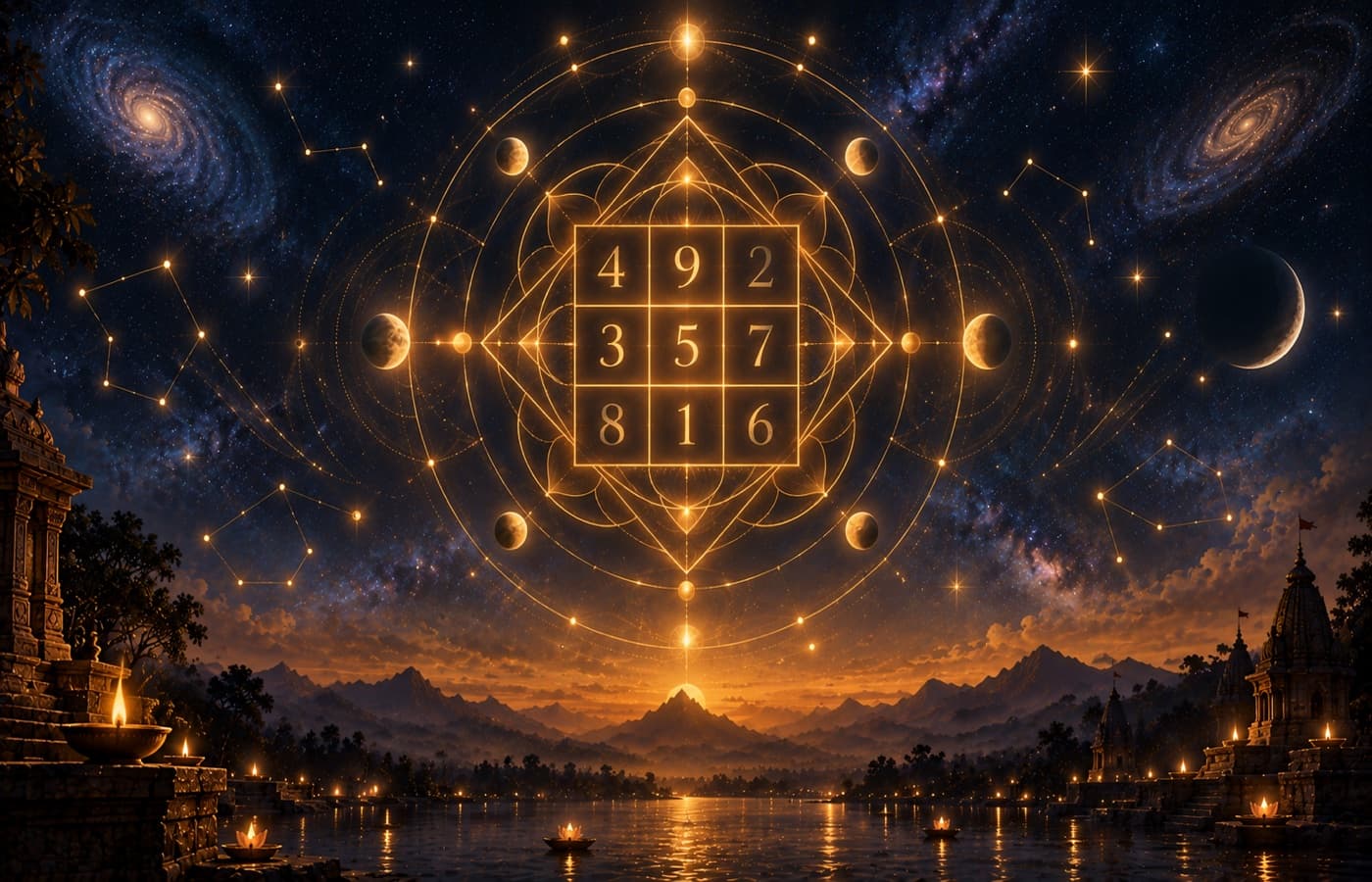
The Loshu is an ancient three-by-three magic square where every line of three sums to fifteen. Your date of birth is placed onto it, so each cell fills with the digits you carry and empties where a number is missing.
The pattern of what is present and what is missing is the grid's reading: strengths that repeat, and qualities to build with intent.
What a full reading covers
Where a number needs strengthening, the tradition offers gentle remedies, a ratna (gemstone), a mantra, a colour or a day to favour. A numerologist tunes these to your numbers rather than prescribing by rote.
Common questions
- Do I need my exact birth time for numerology?
- No. Your Mulank and Bhagyank come from the date alone, and the name numbers from the spelling you use. Time of birth belongs to the kundli, not the numbers.
- Which name should I enter, my full name or my called name?
- Enter the name people actually call you by and that you sign, since that is the sound that repeats around you. You can try both spellings and compare.
- Is a missing number in the Loshu grid a bad sign?
- No. A missing number is read as a quality to build on purpose rather than a fault, and each has a simple, traditional remedy that the full reading lists.