Bisarjan: the long goodbye on the Hooghly
How Kolkata lets the Mother go: the boron farewell and the red storm of sindoor khela, the drum-led procession to the ghats, the immersion in the Hooghly, and the Red Road carnival that now closes the festival.
For four days the city has kept her as its own. On the tenth it must let her go, and Kolkata has turned the letting go into a festival in itself: a morning of sweets and vermilion, an afternoon of drums on the move, an evening at the water where a million goodbyes go into one river.
- Bijoya Dashami 2026
- 21 October 2026
- Dashami tithi ends
- 2:12 PM IST (drik)
- Household and bonedi immersions
- Dashami, from afternoon
- Big committee immersions
- Dashami to the third day after, as the police roster allots
- Red Road carnival
- 24 October 2026
The morning: the Mother is a daughter
In Bengal, Durga is not only the slayer of the buffalo demon. She is Uma, the married daughter who has come home to her parents for four days with her children, and who must now return to her husband on Kailash. Dashami morning is written in that key, tender rather than triumphant. After the last aarti and the short Dashami puja, the priest performs the symbolic immersion at the altar itself: in the old houses the Goddess's reflection is caught in a bowl of water and a mirror, the darpan bisarjan, and it is that reflection, not yet the clay, that is first sent away. The deity is asked to leave the image and take her seat again in the heart.
Boron and the red: the women's farewell
Then the women take over, and the ritual turns into something a family does when a daughter leaves. Baran is the farewell tray: married women touch sweets to the Goddess's lips, offer betel leaf and a sip of water, wipe her face with a cloth, and lean in to whisper the one thing everyone will say aloud by nightfall, come back next year. Sindoor khela follows, the play of vermilion. The same women who did the baran redden the parting of each other's hair and each other's cheeks, press sweets into each other's mouths, until the pandal floor and every white sari are streaked with red. It is the loudest and most photographed moment of the day, and it is still a goodbye. The red is the red a daughter carries away with her when she goes back to her husband's house.
The procession: from the para to the ghat
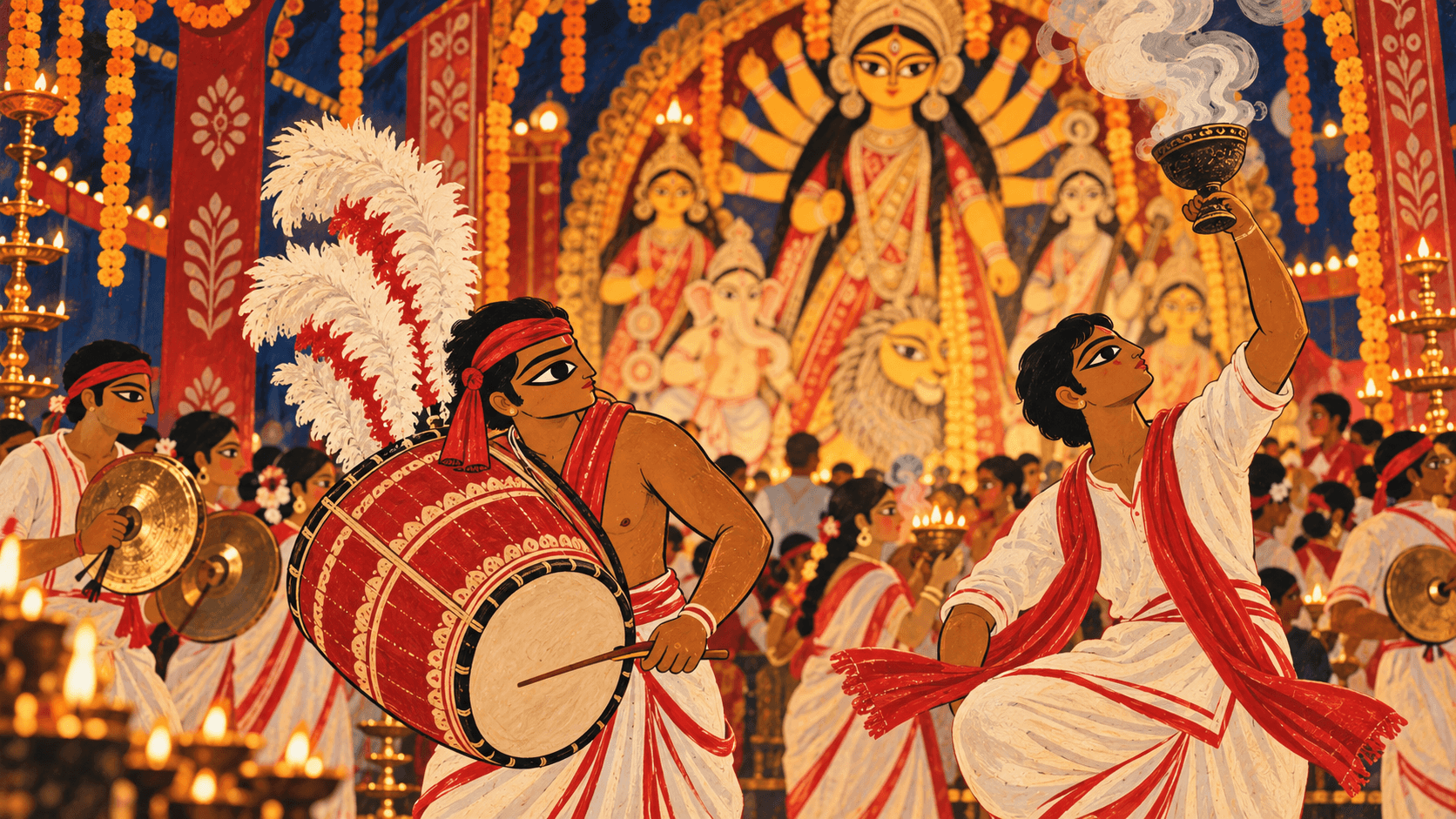
By afternoon the idol is lifted onto a lorry, or in the bonedi houses of North Kolkata onto the shoulders of bearers, as it has been carried for two centuries. The order of the procession is fixed by feeling: the dhakis lead, then the dhunuchi dancers turning in their own smoke, then the family or the committee, then the whole para behind. The route is not left to chance. Kolkata Police allots each committee a day, a road and a ghat, and the largest processions inch down the arterial roads, Rashbehari Avenue, the five-point crossing at Shyambazar, Strand Road, with traffic held and barricades up. If you are in a car anywhere near the river on Dashami evening, you are part of a procession whether you meant to be or not.
The ghats: where the river takes her
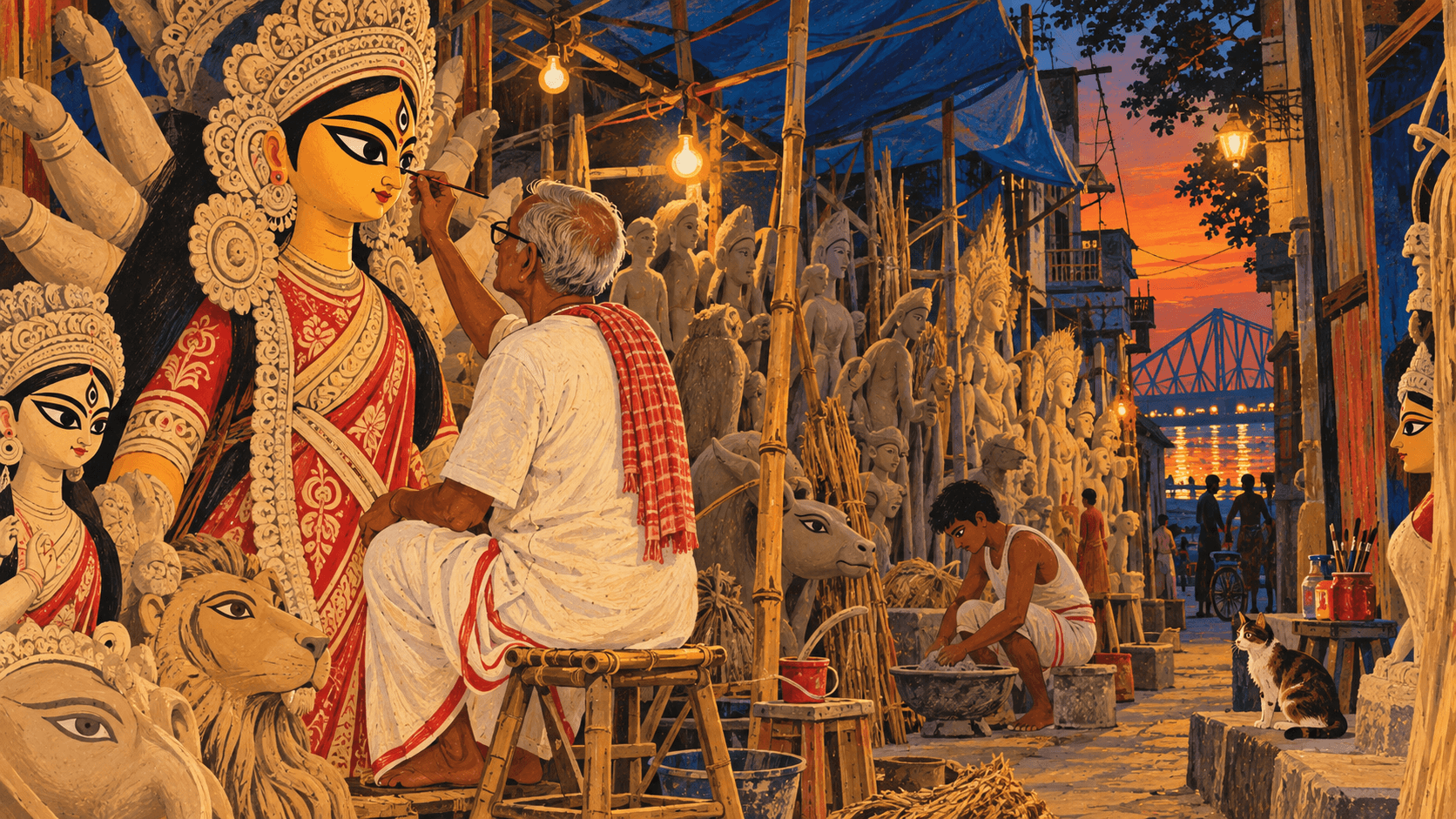
Kolkata does not immerse just anywhere. The police open a fixed set of ghats along the Hooghly and staff each one for the nights it is in use. Babughat, formally Baje Kadamtala Ghat, is the principal ground: cranes, floodlights, a police control room, and the largest crowds in the city, and most South and Central Kolkata committees are routed here. The North Kolkata pujas and many bonedi houses go to Judges Ghat and Nimtala Ghat. In the artisans' quarter the idols return to the water they were born beside, at Bagbazar Ghat and Kumartuli Ghat, a few steps from the workshops where the clay was first pulled out of the riverbank in summer. Gwalior Ghat and Doi Ghat are the quieter alternatives on the same bank, and across the river Howrah sends its own pujas down the Ramkrishnapur and Shibpur ghats.
The river: what actually happens at the water
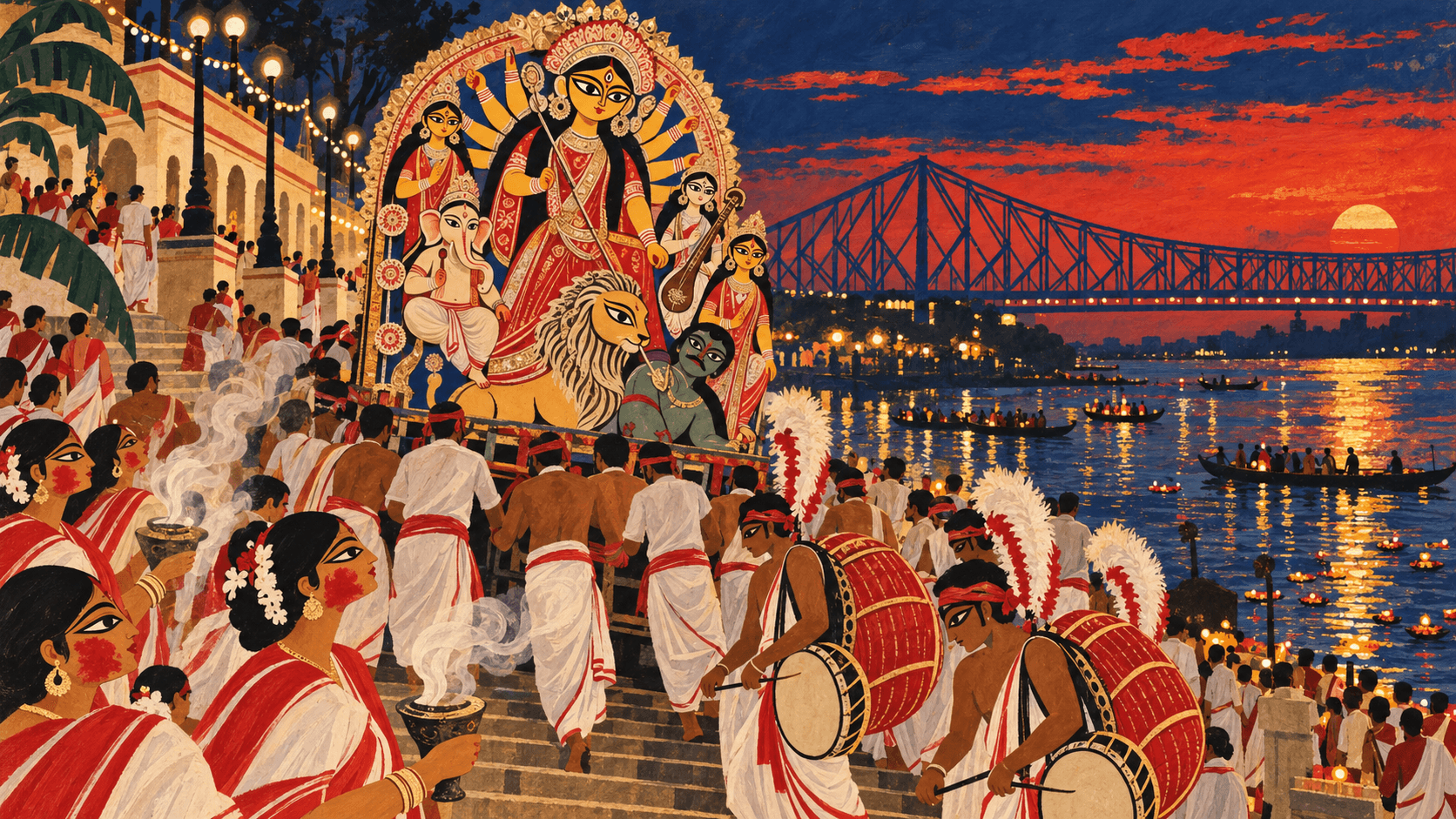
At the ghat the lorry backs down the ramp and the idol comes off the truck for the last time. It is turned, the saptapradakshina, so the Goddess faces every direction once, the priest touches water to her feet, and then she is lowered into the Hooghly. What follows is deliberately unromantic, and it is exactly why the river survives the festival. A crane lifts the frame back out within minutes; the bamboo, straw, paint and clay come onto the bank and into the corporation's trucks, under the pollution rules the state board now enforces at every immersion ghat. On the water the disaster-management launches and divers stay on station through the night, partly to recover a slipped idol and partly to pull out anyone who follows it in. The river takes the Goddess. The city takes back the clay.
Stand on the Babughat embankment after dark and you watch idol after idol go in, each with its own dhak, each crowd lifting the same cry, bolo Durga mai ki, jai. Nobody plans to weep and many do. Then people turn to one another and it is Bijoya: the young stoop to touch the feet of the elders, the elders pull the young into an embrace, kolakuli, and sweets come out of every pocket. The greeting season it opens does not close that night. It runs on for weeks, past Lakshmi Puja and up to Kali Puja, in every visit and every phone call that begins with shubho bijoya.
Asche bochhor abar hobe. Next year, again. It is not a hope. In Kolkata it is a promise made to the river.
The carnival: one last parade on Red Road
Since 2016 the state has held a Durga Puja carnival on Red Road, the ceremonial avenue running along the Maidan, a few days after Dashami. The prize-winning committees hold their idols back from the water for it and parade them past a grandstand, each with a few minutes of dhak, dance and tableau, before rolling on to the ghat for immersion later the same night. UNESCO's 2021 inscription of Kolkata's Durga Puja on its intangible cultural heritage list has turned the carnival into the festival's public showcase, watched by visitors and diplomats from the stands. Seats in the enclosures are allotted by the state, but the free pavements along Red Road and the Maidan side fill hours before the first tableau rolls.