Kumartuli: where the Goddess is made
A walk through the potters' quarter of North Kolkata: the river clay and straw skeletons, the coats that dry and crack, the single brushstroke of Chokkhu Daan, and the families, now with more and more women, who have shaped Durga here for three hundred years.
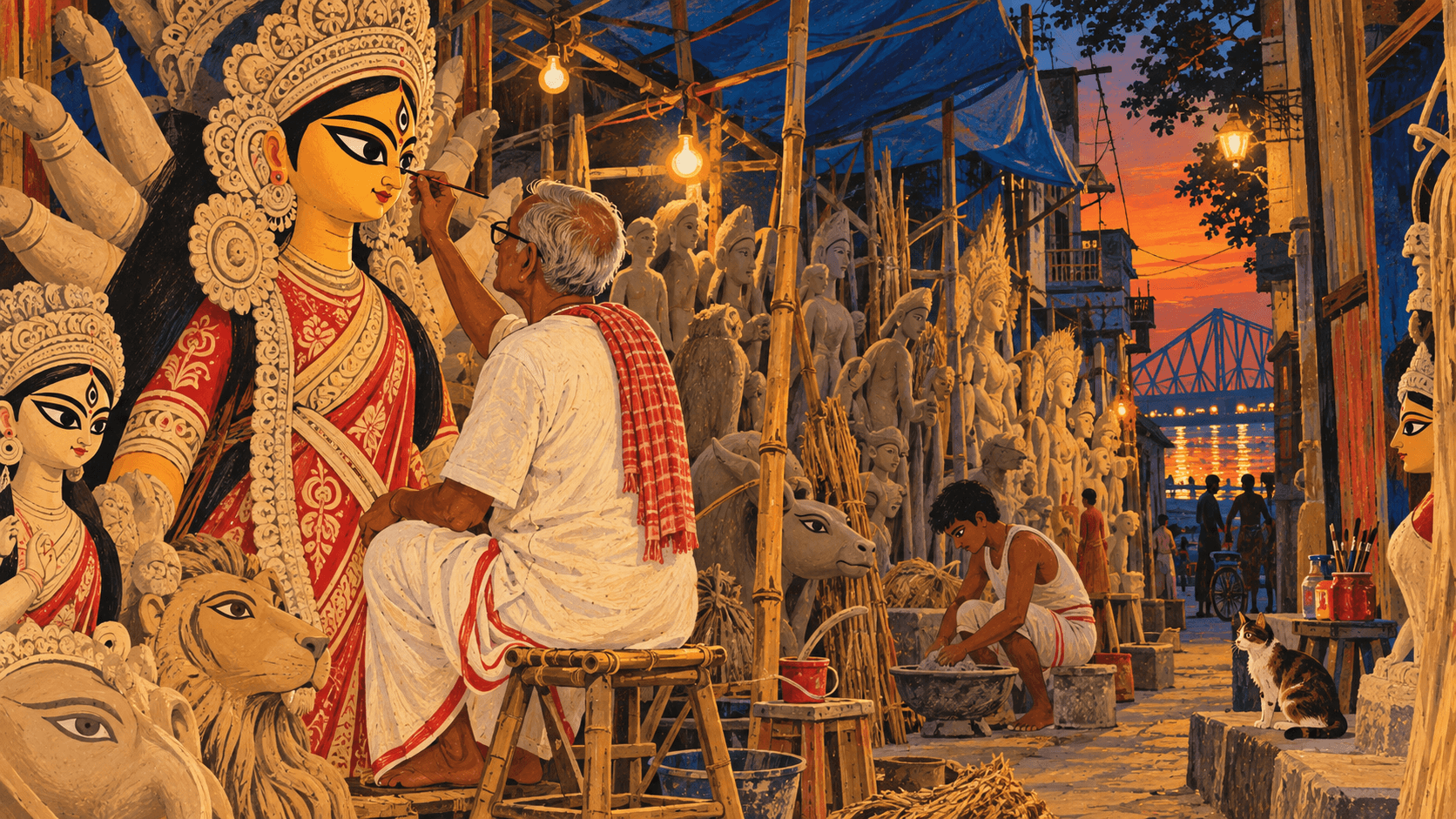
Between Sovabazar and the Hooghly, a grid of lanes barely wide enough for a rickshaw has made the city's goddesses since the eighteenth century. Straw pokes from unfinished limbs, drying idols lean against every wall, and the whole quarter smells of wet earth. For a few weeks each autumn this is the busiest square kilometre in Bengal.
Earth from the river
The Goddess is made of the Ganges. The clay is entel mati, the sticky alluvial silt dredged from the Hooghly's banks, kneaded by foot for days until it is smooth and free of grit. It goes on in coats. The first, coarse and bound with rice husk and jute fibre so it grips the straw, builds the bulk. A finer, sieved clay follows for the skin, thinned almost to a slip for the face and fingers. And by an old custom a pinch of punya mati, earth taken from outside a courtesan's door, is worked into the mix, so that no part of the city, and no life the city would rather forget, is left out of the Mother. Artisans will tell you the custom is kept. They will not always tell you where the handful came from.
The skeleton beneath
No clay touches the idol first. It begins as a skeleton, the kathamo, of bamboo lashed with jute string, and over it the khorer chele, a body of rice straw bound tight with rope into the rough pose, arms flung out, foot on the buffalo demon, before a single handful of earth is laid on. The straw carries the weight and keeps a large idol light enough to lift. Then comes the oldest question of the trade: ek-chala or not. In the classic ekchala, Durga and her four children, Lakshmi, Saraswati, Kartik, Ganesh, share one arched frame of straw and pith, a single tableau. The theme pandals now more often want them apart, each on its own base in a modern pose, which lets the sculptor compose like a stage. Bonedi households mostly keep the old single frame, because that is how the family has always seen her.
Coats, cracks and the sun
Clay work is a race against water. Each coat must dry before the next goes on, in the sun when there is sun and under bare bulbs and fans when there is not, and drying is exactly when clay cracks. A crack across a cheek at this stage is a day lost, filled and smoothed and dried again. The whole calendar is cruel: the idols must be built through the last weeks of the monsoon, in lanes that flood ankle-deep, under tarpaulins and asbestos roofs that leak, with the river's damp never leaving the air. A wet September can ruin a month of work, and every artisan watches the sky more anxiously than the order book. Only once the clay is bone dry does the painting begin, a base wash first, then the skin tone, the red border of the sari, the ornaments picked out by hand.
The idol is finished when the eyes are painted. Until then it is clay. After that, you lower your voice.
The gift of sight
The eyes are painted last, traditionally on the dawn of Mahalaya, the day the Goddess is invoked to begin her journey home. The master does it alone, often after a bath and a fast, drawing each eye in a few unbroken strokes: the long almond outline, the dark iris, and the third eye on the brow. This is Chokkhu Daan, the giving of eyes, and the workshop believes it is the moment the clay becomes the Devi and begins to see. The hush is real. Visitors are asked to stand back and phones are lowered. In practice the deadline pushes the ritual around, and many idols get their eyes in the days after Mahalaya as committees take delivery. Then the lanes fill with lorries near midnight, idols wrapped in plastic against a last shower, moving out to every corner of the city.
Dressing the Goddess
The painted idol still has to be dressed, and the decoration, the saaj, is a craft of its own. The oldest and most Bengali is sholar saaj, ornaments cut and carved from shola, the soft white pith of an aquatic plant, into crowns, garlands and the filigree halo behind the head, light as paper and dazzlingly white. Grander pujas favour daker saaj, so named because the silver and gold foil and the bright zari were once ordered by post, dak, from Germany, and the trade name stuck. Beside these, the tinsel and sequins of modern saaj, and for theme pandals whole schemes in cloth, jute, metal or terracotta, designed to match the pandal rather than tradition. The dressing is often done by different hands than the sculpting, and in the last days before delivery a studio can hold a fully painted Durga still waiting for her crown.
The families, the women, the world
The potters, the Kumbhakars, were settled here by the colonial town planning of the 1700s, each caste to its own quarter, and their descendants still hold the studios. The Pal surname carries the trade's reputation, a lineage of master sculptors handing the work from father to son and, increasingly, to daughter. Kumartuli was long a closed world of men, but a growing number of women now run studios of their own, sculpting full idols under their own name rather than only fetching clay and finishing ornament, a shift the quarter itself still argues about. The economics stay hard: months of work priced against a festival that pays late, rents rising, the young often leaving for steadier trades. What keeps it alive, besides the pujas of the city, is the world. Kumartuli ships idols abroad every year, many in fibreglass so they survive a container crossing, to Durga Pujas in London, New Jersey, Toronto, Sydney and Dubai.