Bonedi bari: the household pujas that came before the pandal
Before the sarbojanin committees and their theme pandals, Durga Puja belonged to the great houses of old Kolkata, kept on the thakurdalan of a family's own mansion. Many of those courtyards still open their gates for four days each autumn. What a bonedi puja is, how the houses came to be, and how to stand in one with grace.
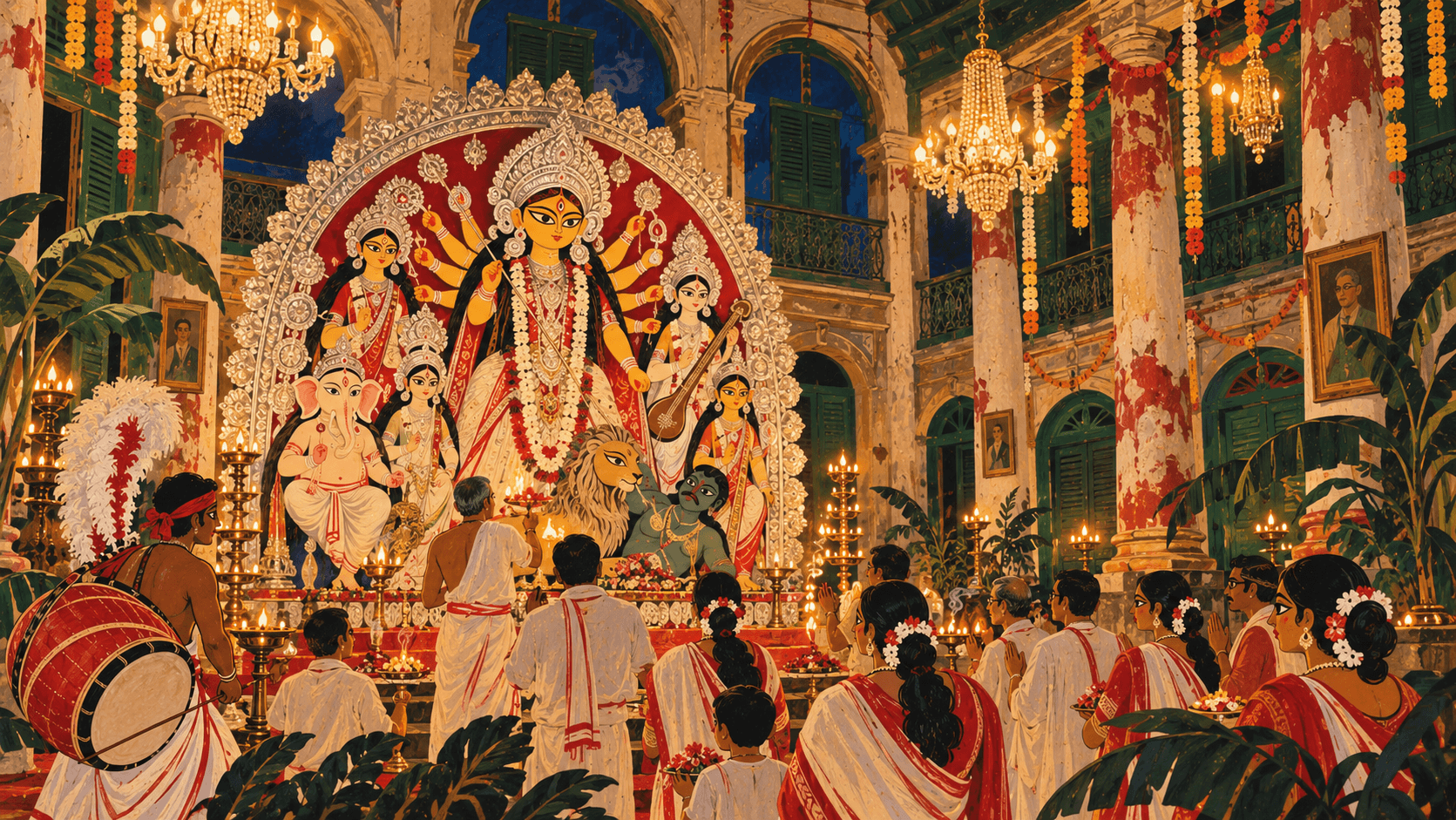
The pandal is a twentieth-century idea. For the two hundred years before it, the Goddess did not come to the street. She came to the courtyards of the zamindars and merchants of Sutanuti and Gobindapur, and the whole city walked to their gates to see her.
What 'bonedi' means
Bonedi comes from the Persian buniyad, a foundation, and in Bengali it means a family of old standing, aristocratic by lineage rather than by this year's money. A bonedi bari puja is one a single family has kept in its own home, year on year, often since the seventeen or eighteen hundreds. The stage for it is the thakurdalan: a raised, pillared hall, open along one long side to an inner courtyard, built into the mansion for exactly this worship and used for little else the rest of the year. The arches, the lime-plaster columns, the chandeliers brought back from Europe, the household deities in a room off to the side, all of it was designed so that the Goddess could be installed facing the courtyard while the family and the neighbourhood gathered in front of her, under the open sky.
How the great houses began
The oldest of these pujas predate the city. The Sabarna Roy Choudhury family of Barisha, the original landlords of the three villages the East India Company would buy to make Calcutta, trace their household puja to the early sixteen hundreds, generations before Job Charnock. But the golden age of the bonedi puja was the century after Plassey. Raja Nabakrishna Deb of Sovabazar is said to have begun his puja in 1757, the year the Company won Bengal, and to have entertained the British in the thakurdalan. Fortunes made as banians and dewans to the Company, as merchants in the new port city, went into brick, marble and a puja that announced a family had arrived. Rani Rashmoni of Janbazar, who would later build Dakshineswar, kept her own. So did the sons of Ramdulal Dey, the Chhatu Babu and Latu Babu of Beadon Street. To hold Durga Puja on your own thakurdalan was, for a Bengali house of the eighteenth and nineteenth centuries, the surest statement of standing there was.
The ekchala and the daker saaj
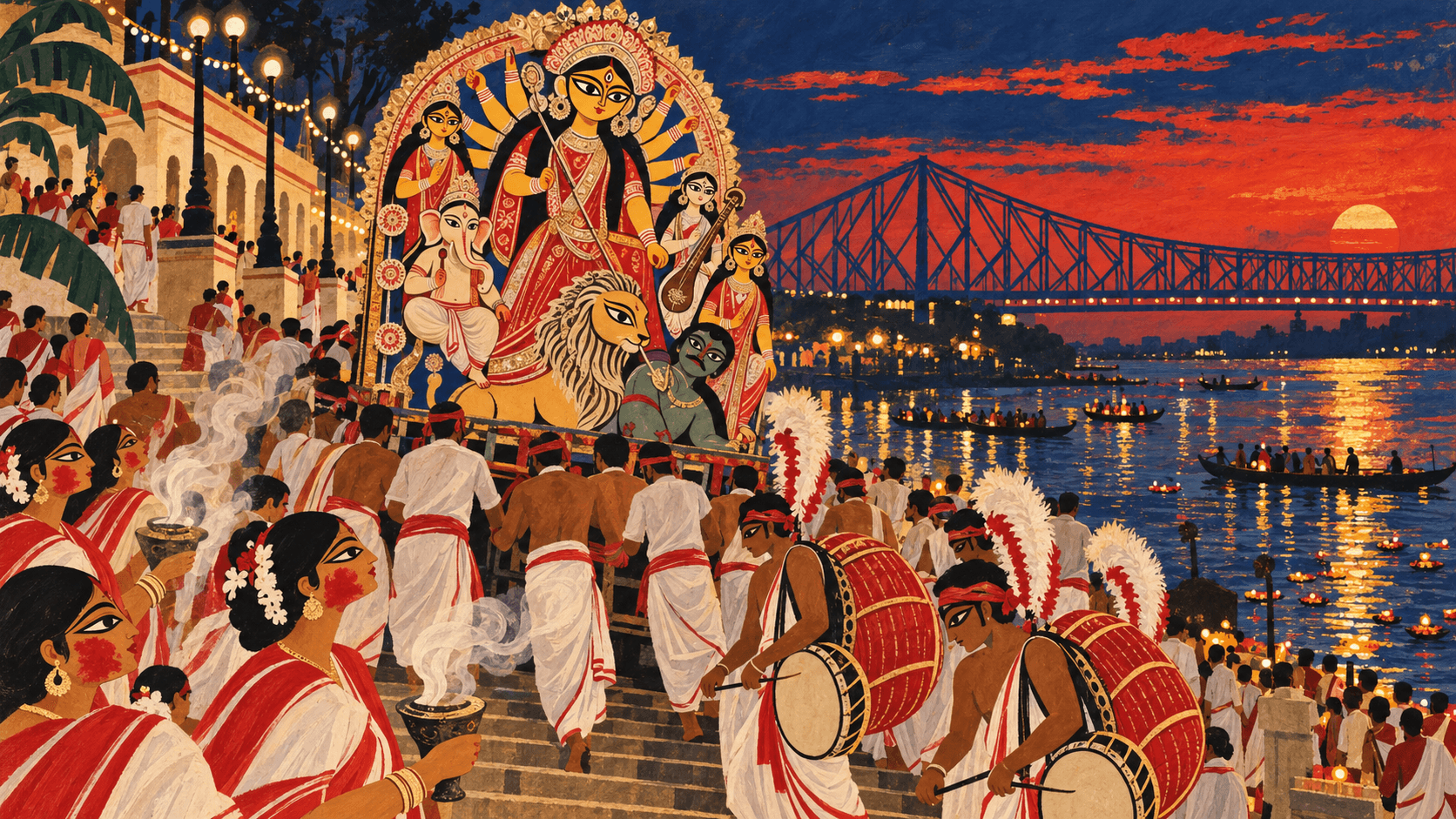
You can tell a bonedi idol from a pandal idol across the courtyard. It is nearly always ekchala, the sabeki form: Durga and her four children, Lakshmi, Saraswati, Kartik and Ganesh, set together under a single arched wooden frame, the chalchitra, rather than on the separate platforms the theme pujas favour. The Mother's face is the round, long-eyed daker mukh of the old moulds, not the sculpted realism of modern Kumartuli. Over it goes the dressing that gives the style its name. Daker saaj is ornament of beaten silver and gold foil, once shipped in by post, by dak, from Germany, which is where the word comes from. Sholar saaj is its white cousin, filigree cut by hand from the pith of the shola reed, light as paper and worked into crowns and garlands. In many houses the idol is not bought at all: a family of hereditary artisans comes to the courtyard weeks ahead and builds her there on her frame, straw to clay to colour, the same family that built last year's.
The family's own rites
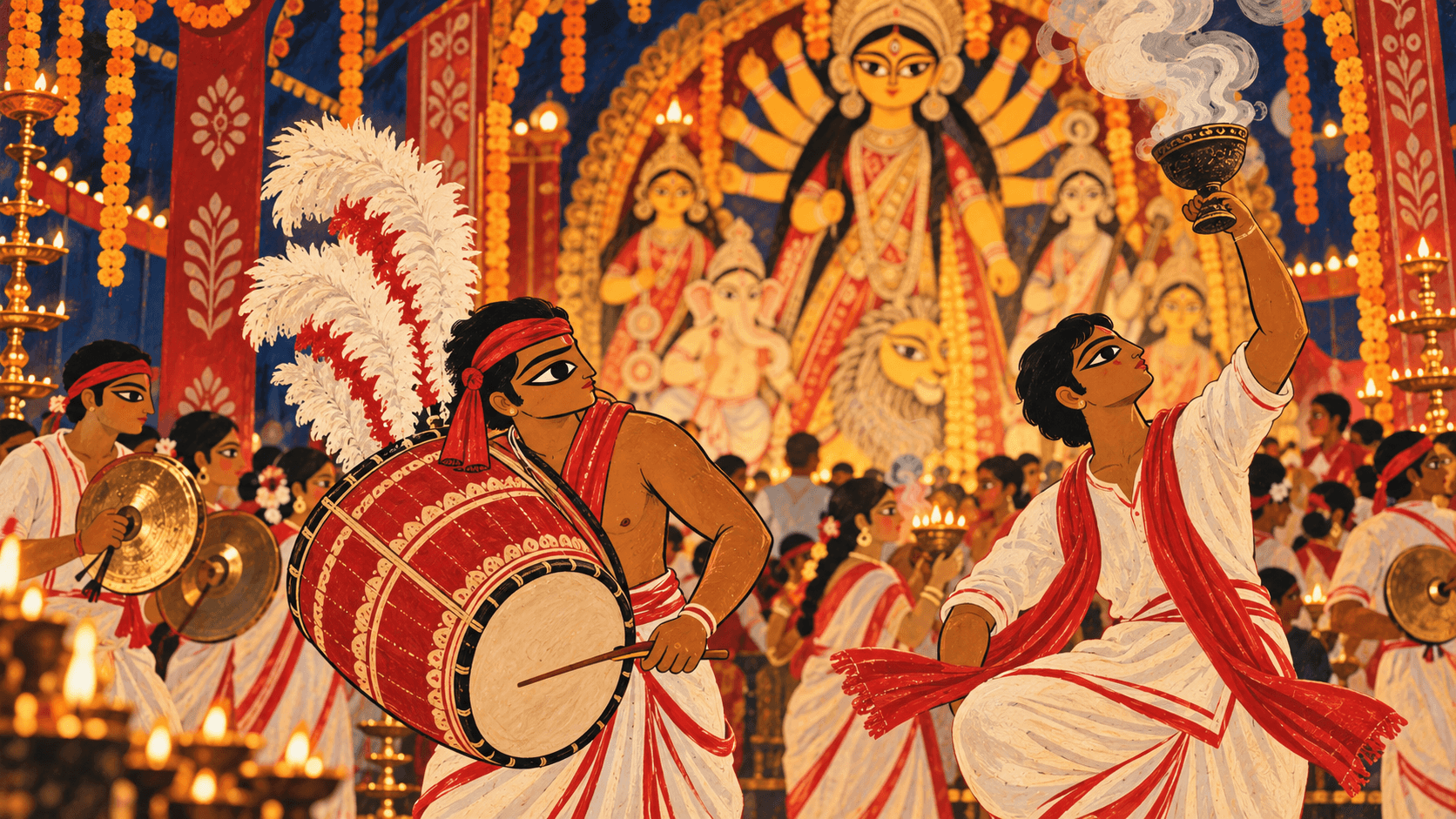
There is no competition here, and so the rituals are the whole of it, done the way one family has always done them. The house has its own priest, often a lineage of priests who have served it for generations and who know its particular usages: which house does bodhan on Shashthi and which begins earlier, whether the bhog is cooked with onion and garlic or without, whether the family still follows an animal offering or replaced it long ago with the cut of a sugar cane or an ash gourd. Kumari puja, the worship of a young girl as the living Goddess, is kept in many houses on Ashtami. Sandhi puja, the joined moment of Ashtami and Nabami when the Goddess is said to have slain the demon, is lit with rows of lamps in the courtyard and, in the old days, marked by a cannon or a relay of conch shells from house to house. On Nabami evening the dhunuchi is danced before her on the thakurdalan floor, not on a stage. Every one of these customs is a family's, inherited and unchanged, and that is the point of coming: you are watching something that has not been redesigned for you.
Bhog, and the family table
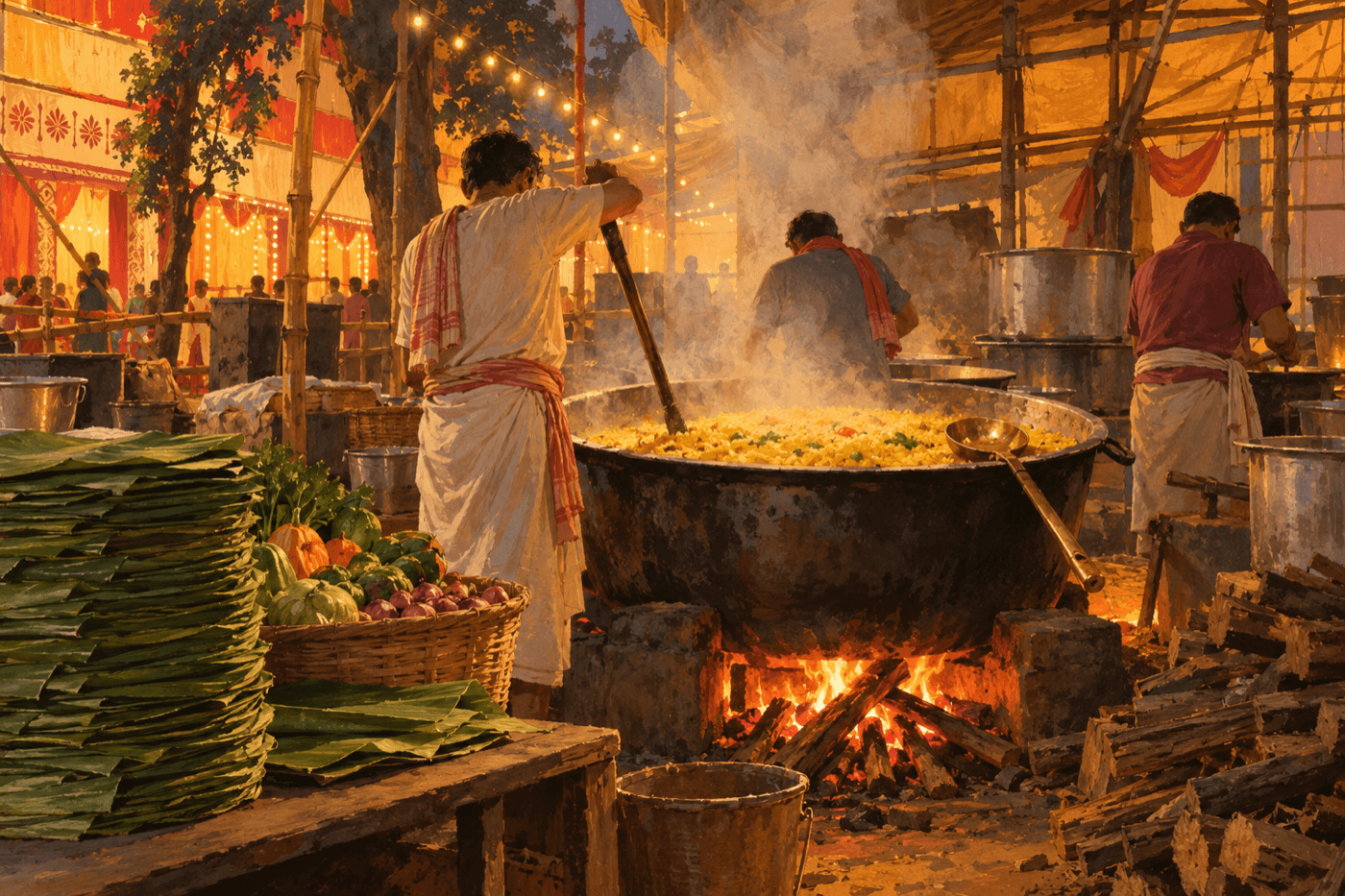
Food in a bonedi house is worship before it is a meal. The bhog offered to the Goddess follows the family's own rule: many old houses keep a strictly vegetarian, no-onion, no-garlic niramish bhog through the days, khichuri with five or seven vegetable fries, labra, chutney, payesh; others, by inherited custom, offer fish or the meat of the sacrifice on a particular day. What is cooked for the deity is made in enormous brass and bell-metal vessels in the household kitchen, offered, and then shared, first with the family and the priests, then with whoever is in the courtyard. In some houses the tradition is that no one who comes on Ashtami leaves without at least a little prasad in the palm. The recipes travel down the same female line as the family itself, and a daughter married away will still cook her mother's puja payesh in her own kitchen a thousand miles from Kolkata.
In a pandal you look at the Goddess. In a thakurdalan the Goddess looks at you, because she has been in that room longer than the family.
A quieter kind of darshan
Step in from a barowari street and the change of register is physical. The sarbojanin pandal is a public spectacle, loud, competitive, engineered for the crowd and the prize jury; the bonedi courtyard is a house at prayer that has left its gate open. It is quieter, slower and ritual-first, and it asks something of the visitor in return: you come as a guest, not an audience. Many of these houses are struggling to survive. The joint families that ran them have scattered across the world, the mansions are expensive to hold up, and the share of the cost that once fell on a whole clan now falls on the few who stayed. Some pujas have shrunk, some have moved to a rented hall, a few have stopped. Against that, heritage walks, conservation trusts and a younger generation returning for the four days are keeping many of the courtyards lit. When you visit and give respectfully, you are part of what keeps the gate open.
How to visit
Most of the famous houses cluster in North Kolkata, within a walk of the Sovabazar Sutanuti, Girish Park and Shobhabazar metro stations, in the lanes of Sutanuti, Pathuriaghata, Jorasanko, Darjipara and Thanthania; the Sabarna Roy Choudhury houses are south, at Barisha in Behala. A Saptami or Ashtami morning is the time to go. The courtyards are calm, the morning pushpanjali is open to anyone who arrives clean and on time, and someone of the house will usually tell you what you are looking at if you ask gently. Evenings belong to the aarti and the dhunuchi and fill quickly. The easiest way in for a first-timer is a guided heritage walk: several run through the bonedi para over the puja days, and a good guide gets you past the gate and into the story. Otherwise the gates are genuinely open; you can walk in, quietly.